
Industry Insights
Understanding Size Grading in Sportswear

1. Introduction: Why Size Grading Matters in Sportswear Manufacturing
When people talk about sportswear, they usually focus on fabric, stitching, or design. But in real manufacturing, one of the most important factors that decides whether a product will succeed in the market is size grading.
Size grading is what ensures that a t-shirt in small, medium, large, and extra-large all fit correctly according to real human body differences, not just scaled-up drawings.
In sportswear, this becomes even more critical because customers expect comfort during movement, stretching, sweating, and training. If the sizing is wrong, the product may look good but will fail in real use.
From a manufacturing point of view, poor size grading is one of the biggest reasons for returns, complaints, and brand dissatisfaction.
This is why professional sportswear brands treat grading as a technical process, not a guesswork activity.
2. What is Size Grading in Simple Terms
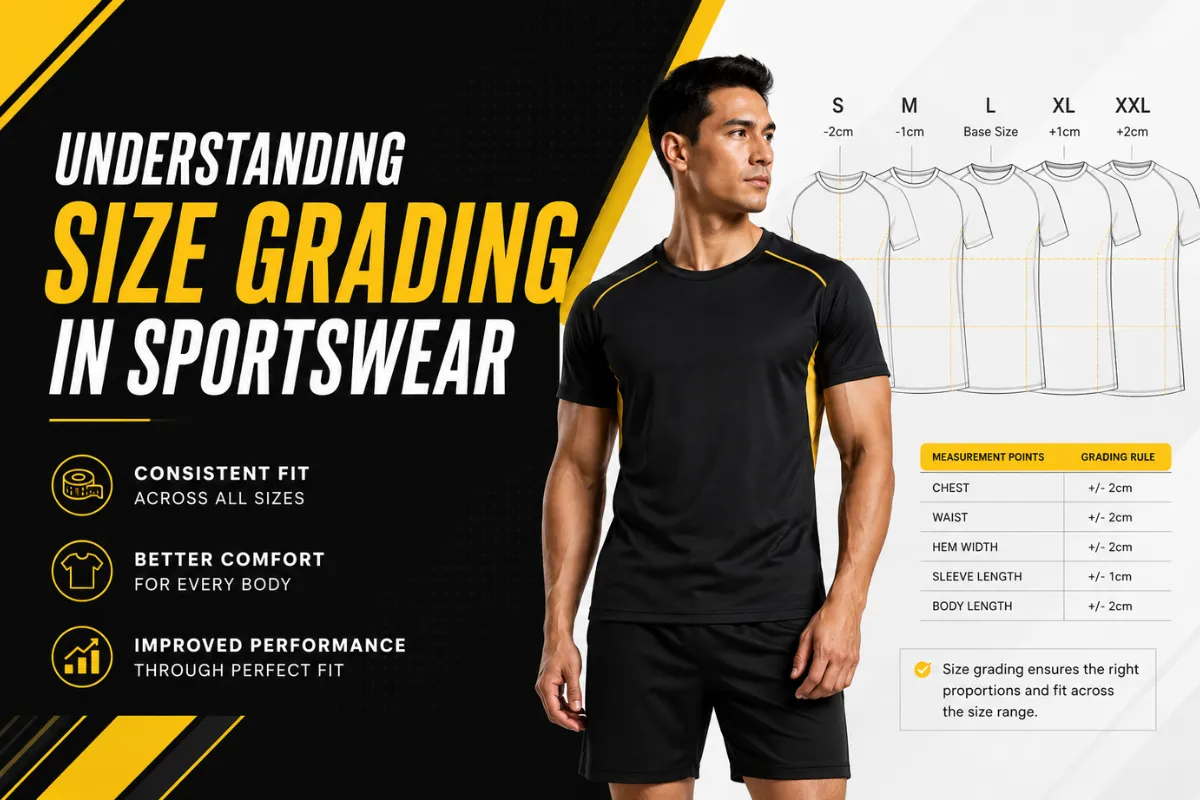
Size grading means converting one base size into multiple sizes using a structured measurement system.
Instead of designing S, M, L, XL separately, manufacturers first create one “base size” and then adjust measurements up and down to create other sizes.
Simple explanation:
- Base size = reference fit (usually Medium or Large)
- Grading = increasing or decreasing measurements step by step
Easy way to understand:
Think of it like scaling a drawing, but with rules so that proportions stay correct.
If grading is not done properly, a large size may feel too long, or a small size may feel oddly shaped.
3. Why Size Grading is Important in Sportswear
Size grading directly impacts customer experience and brand trust.
Key reasons:
- Ensures consistent fit across all sizes
- Improves comfort during workouts and movement
- Reduces product returns and size exchanges
- Builds trust in your brand sizing system
Manufacturing insight:
In sportswear, even a 1 – 2 cm mistake in grading can affect performance comfort, especially in compression wear or fitted gym apparel.
4. How Size Grading Works in Sportswear Manufacturing
4.1 Base Size Concept
In most sportswear production, manufacturers start with a base size. This is usually Medium or Large depending on the target market.
The base size is the reference point for all other sizes.
4.2 Grading Rules
Grading is done using controlled increments.
For example:
| Measurement Area | Increment Logic |
| Chest | +2 to +4 cm per size |
| Waist | +2 to +3 cm per size |
| Length | +1 to +2 cm per size |
| Sleeve | +1 to +1.5 cm per size |
These values are not random. They are adjusted based on product type, fabric stretch, and fit style.
4.3 Simple grading flow
- Start with Medium size
- Increase measurements for Large and XL
- Decrease measurements for Small and XS
- Maintain proportional balance
Manufacturing insight:
Good grading keeps proportions natural. Bad grading makes sizes look “off” even if measurements are technically correct.
5. Key Measurement Points in Sportswear Grading
These are the most important areas where grading adjustments are made:
- Chest width
- Waist width
- Hip area
- Total length (top and bottom)
- Sleeve length
- Armhole depth
- Inseam length for bottoms
Each point affects how the garment behaves during movement.
6. Standard Size Charts in Sportswear
Below is a simplified size grading example used in many sportswear productions:
| Size | Chest | Waist | Length | Fit Description |
| S | Base – small reduction | Slim | Slightly shorter | Tight athletic fit |
| M | Base size | Standard | Standard length | Balanced fit |
| L | +2 – 4 cm | Slightly relaxed | Slightly longer | Comfortable fit |
| XL | +4 – 6 cm | Relaxed | Longer fit | Loose comfort fit |
| XXL | Maximum increment | Full relaxed | Extended length | Plus-size comfort fit |
Important note:
These are not fixed rules. Each brand has its own fit identity.
7. Size Grading for Different Sportswear Products
7.1 Gym T-Shirts and Tops
- Focus on chest and shoulder balance
- Fit should allow movement without tight restriction
- Too loose grading reduces athletic appearance
7.2 Compression Wear
- Very tight grading system
- Minimal difference between sizes
- Fabric stretch is more important than measurement alone
7.3 Hoodies and Tracksuits
- More relaxed grading approach
- Focus on comfort and layering space
- Length variation is more noticeable
7.4 Leggings and Bottoms
- Waist and hip are critical
- Inseam must match body height differences
- Stretch factor changes grading logic significantly
8. Common Mistakes in Size Grading
From manufacturing experience, these are the most frequent issues:
- Using fashion sizing rules for sportswear
- Ignoring fabric stretch behavior
- Uneven increments between sizes
- Copying competitor size charts without testing
- Not considering real body movement during workouts
Result:
Products may technically match measurements but still feel uncomfortable in real use.
9. How Poor Size Grading Affects Sportswear Brands
| Problem | What Happens | Business Impact |
| Wrong fit | Customers feel discomfort | Low repeat sales |
| Size mismatch | Frequent returns | Increased cost |
| Inconsistent sizing | Trust issues | Brand damage |
| Poor grading logic | Production confusion | Delays and waste |
Manufacturing truth:
Most return issues in sportswear are not fabric problems, they are sizing problems.
10. How We Handle Size Grading in Manufacturing
At the production level, size grading is treated as a technical process, not estimation.
Our approach:
- We first create a base size sample
- We define grading rules based on product type
- We adjust increments for fabric stretch and fit style
- We test samples in real wear conditions
- We finalize grading before bulk production
If you are building your own brand, we help you structure this process so your sizing remains consistent across every order.
You can explore more about our development approach through our sportswear manufacturing process where we align sizing, fabric, and production together.
11. How to Choose the Right Size Strategy for Your Brand
Key considerations:
| Factor | Impact on Sizing |
| Target market region | US/EU sizing differs from Asia |
| Product type | Compression vs loose fit changes grading |
| Fabric type | Stretch fabrics need tighter grading |
| Brand identity | Oversized vs athletic fit strategy |
Simple advice:
A strong brand does not use one size chart for everything. It adjusts grading based on product category.
FAQs
Size grading is the process of creating multiple clothing sizes from one base size using structured measurement changes. It ensures that all sizes maintain correct proportions instead of just being randomly scaled versions of one design.
Because it ensures fit consistency across all sizes. Without proper grading, a product may fit well in medium size but feel uncomfortable or incorrectly shaped in other sizes, leading to returns and customer dissatisfaction.
Manufacturers first create a base size sample. Then they apply measurement increments or reductions to create smaller and larger sizes while maintaining proportion. These changes are calculated, not guessed.
A base size is the reference size used to build all other sizes. Usually Medium or Large is chosen as the base because it represents the average body type for the target market.
Because each brand uses different grading rules, fit preferences, and target markets. One brand may use tighter athletic fits, while another uses relaxed or oversized fits.
Common causes include incorrect grading increments, ignoring fabric stretch behavior, and not testing garments on real body movement. These mistakes make clothes feel different from intended design.
Manufacturers start with a base size, define measurement points, and apply grading rules for each size step. These charts are then tested and adjusted before final production.
Yes. Stretch fabrics allow more flexibility, so grading increments are often smaller. Without adjusting for stretch, garments can become too loose or too tight.
By using accurate grading, testing samples properly, and matching sizing strategy with real customer body types. Consistency is more important than wide size variation.
There is no single system. The best approach depends on product type, fabric, and target market. Performance wear needs tighter grading, while lifestyle wear needs relaxed grading.
Why Accurate Size Grading Builds Strong Sportswear Brands
Size grading is one of the most overlooked but most important parts of sportswear manufacturing.
When done correctly, it ensures that every size feels consistent, comfortable, and reliable. When done poorly, even a high-quality product can fail in the market.
Strong sportswear brands do not treat sizing as a simple chart. They treat it as a structured system that connects design, fabric, and customer experience.
When your sizing is accurate, your customers trust your brand and that trust is what drives long-term growth.


