
Industry Insights
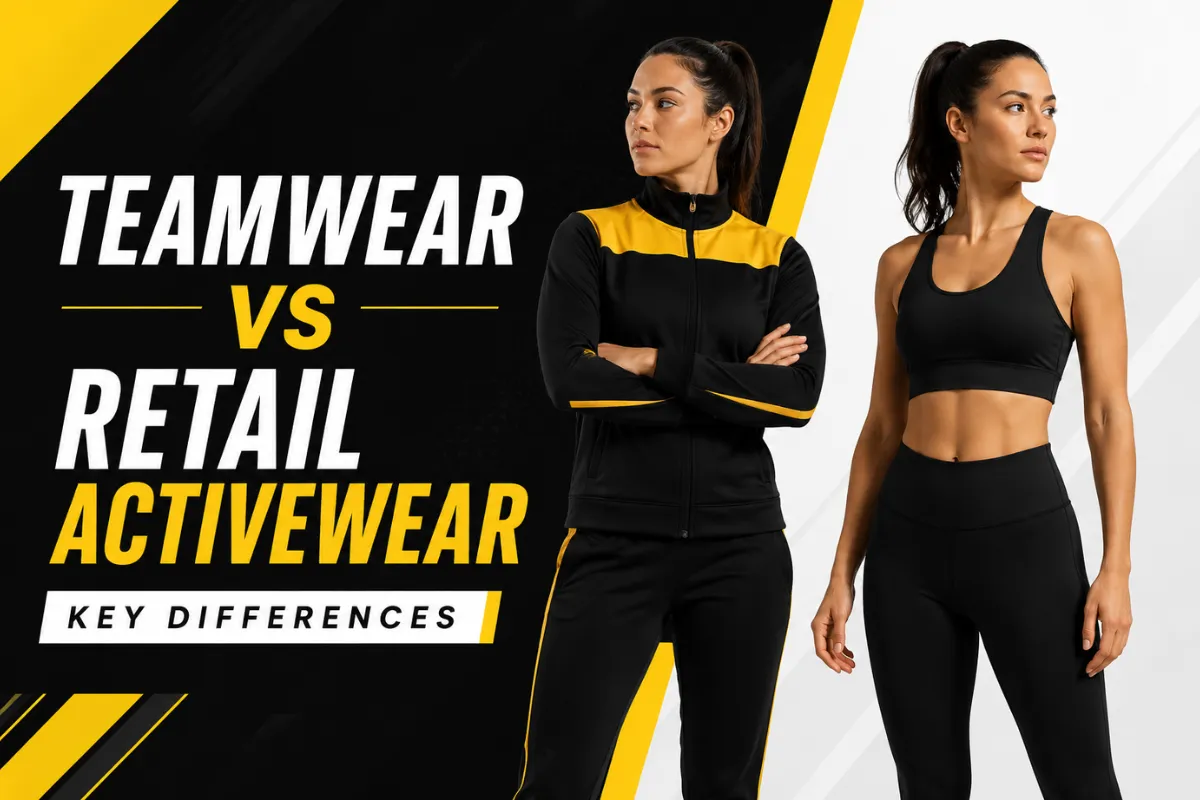
Teamwear vs Retail Activewear: Key Differences

1. Introduction: Why This Difference Matters More Than Most Brands Realize
When people enter the sportswear business, they often assume all sports clothing is the same. A jersey, a gym t-shirt, a tracksuit, or a hoodie all look similar on the surface.
But from a manufacturing and business point of view, teamwear and retail activewear are two completely different systems.
This is where many new brands make mistakes. They treat both categories the same in terms of pricing, fabric selection, production planning, and marketing. The result is confusion in production, delays in delivery, and weak positioning in the market.
If you understand this difference properly from the beginning, you make better decisions in fabric, design, costing, and scaling. This is not just product knowledge. This is business clarity.
2. Understanding Teamwear and Retail Activewear
Before going technical, let’s simplify both.
Teamwear
Teamwear is sports clothing made for groups. These groups can be sports teams, schools, academies, or companies. The main idea is uniformity. Everyone wears the same design with small custom changes like names, numbers, or logos.
Retail Activewear
Retail activewear is sportswear made for individual customers. It is sold through online stores or retail shops. The focus is not uniformity, but style, comfort, fitness performance, and brand identity.
Simple explanation:
- Teamwear = One design for many people
- Retail activewear = Different styles for different customers
From a manufacturing point of view, this difference changes everything from production flow to fabric selection.
3. What is Teamwear?
3.1 Simple definition
Teamwear is uniform-based sportswear designed for group identity and performance consistency.
It is not about fashion trends. It is about giving a team a professional, unified look.
3.2 Where teamwear is used
- Sports clubs and academies
- School and college teams
- Corporate sports events
- Local and professional tournaments
3.3 How teamwear is designed
Teamwear design is very structured and repeatable.
- Same design repeated in bulk
- Logos placed in fixed positions
- Player names and numbers added
- Minimal design changes over time
3.4 Manufacturing reality of teamwear
From production side, teamwear is more stable because:
- Same designs are repeated multiple times
- Fabric requirements are predictable
- Less design variation means smoother production flow
But it also means pricing must stay competitive because buyers compare directly on cost and durability.
4. What is Retail Activewear?
4.1 Simple definition
Retail activewear is sports and fitness clothing designed for individual consumers who buy based on style, comfort, and brand appeal.
4.2 Where retail activewear is used
- Gym and fitness users
- Online sportswear customers
- Athleisure lifestyle market
- Fashion-driven fitness brands
4.3 How retail activewear is designed
Retail activewear is very different from teamwear in design approach.
- Constantly changing styles
- Seasonal collections
- Multiple colors and variations
- Strong focus on branding and presentation
4.4 Manufacturing reality of retail activewear
From a production perspective:
- More sampling is required
- Fabric variations are higher
- Designs change more frequently
- Quality and finishing standards are stricter
Retail activewear is more complex but offers higher brand value if managed correctly.
5. Key Differences Between Teamwear and Retail Activewear
| Feature | Teamwear | Retail Activewear |
| Main purpose | Group identity | Individual fitness and lifestyle |
| Design style | Simple and repeated | Trend-based and changing |
| Customization | High (names, numbers, logos) | Medium (branding focus) |
| Fabric choice | Durability focused | Comfort and aesthetics focused |
| Production type | Bulk repeat orders | Seasonal collections |
| Buyer type | Organizations and teams | Individual customers |
| Pricing logic | Cost-based | Brand value-based |
| Sales cycle | Long-term repeat orders | Fast-moving demand |
Simple manufacturing insight:
Teamwear is stable but repetitive. Retail activewear is flexible but unpredictable.
6. Fabric Differences in Teamwear vs Retail Activewear
Fabric selection is one of the biggest differences between both categories.
| Category | Fabric Type | Why it is used |
| Teamwear | Polyester interlock, mesh, basic knits | Strong, durable, and cost-effective |
| Retail activewear | Polyester-spandex, nylon blends | Stretch, comfort, and premium feel |
Easy explanation:
- Teamwear fabric is built to survive heavy use and washing
- Retail activewear fabric is built to feel good on the body
7. Design and Customization Differences
Teamwear design approach
Teamwear design is very structured:
- Same design used across entire team
- Focus on logo placement and visibility
- Player names and numbers are added
- Very little fashion variation
Retail activewear design approach
Retail design is completely different:
- New designs introduced regularly
- Fashion trends influence styles
- Branding is part of identity
- Color combinations change often
Manufacturing insight:
Teamwear is predictable. Retail activewear is dynamic.
8. Production and Manufacturing Differences
| Factor | Teamwear | Retail Activewear |
| Production planning | Simple and repeatable | Complex and changing |
| MOQ | Flexible and lower | Higher for collections |
| Sampling | Faster approval | Multiple revisions |
| Production cycle | Repeat bulk orders | Seasonal production |
| Complexity level | Low to medium | Medium to high |
Simple manufacturing truth:
Teamwear is easier to control. Retail activewear requires more management.
9. Pricing and Business Model Differences
Teamwear pricing logic
Teamwear is priced mainly on cost, quantity, and durability. Since customers are usually organizations, they compare prices directly.
Retail activewear pricing logic
Retail activewear pricing includes brand value, design appeal, packaging, and customer perception. Customers are willing to pay more if the brand feels premium.
| Factor | Teamwear | Retail Activewear |
| Pricing method | Cost per unit | Brand-based pricing |
| Margin level | Moderate | Higher potential |
| Buying behavior | Bulk decision | Emotional purchase |
10. Common Mistakes Brands Make
From manufacturing experience, these are the most common issues:
- Treating retail activewear like simple teamwear production
- Using teamwear fabrics for retail collections
- Ignoring customization requirements in teamwear
- Over-designing teamwear products unnecessarily
- Mispricing retail products using cost-only logic
Result of these mistakes:
- Delayed production
- Poor product positioning
- Weak brand identity
- Reduced profit margins
11. How to Decide What Your Brand Should Focus On
This decision depends on your target market.
Simple decision guide:
| If your target is | You should focus on |
| Schools, clubs, academies | Teamwear |
| Gym users and fitness market | Retail activewear |
| Both markets | Separate systems for both |
Manufacturing advice:
For new brands, starting with one category is often safer because it reduces complexity in production and helps build strong market positioning first.
If you are unsure, working with an experienced OEM sportswear manufacturer can help you define the right starting point based on your budget and market.
12. How We Help Brands in Both Categories
As a sportswear manufacturer, we handle both categories but with different production strategies.
Our support includes:
- Teamwear OEM production for clubs and organizations
- Retail activewear private label development
- Fabric selection based on category needs
- Sampling and bulk production management
- Export-ready manufacturing systems
We ensure each category is produced with the right system instead of forcing one approach for both.
FAQs
Teamwear is made for groups and focuses on uniform identity. Activewear is made for individuals and focuses on fitness, comfort, and lifestyle. The difference is mainly in usage purpose and design flexibility.
Neither is absolutely better. Teamwear gives stable repeat orders and predictable production. Retail activewear gives higher branding potential and profit margins but requires more investment in design and marketing.
Yes, retail activewear can generate higher profit margins because pricing is based on brand value. However, it also requires more investment in branding, design development, and customer acquisition.
Yes, but it requires separate planning. Both categories have different production cycles and customer expectations. Mixing them without structure often leads to confusion in manufacturing and pricing.
OEM teamwear production means the manufacturer produces customized uniforms based on your design, while you handle branding and sales. The manufacturer manages fabric sourcing, stitching, and finishing.
Teamwear customization is functional, including names, numbers, and logos for identification. Retail activewear customization is more about brand identity and design aesthetics rather than personalization.
Teamwear usually has lower MOQ because designs are repeated and simpler. Retail activewear often requires higher MOQ due to multiple styles, colors, and variations in one collection.
Teamwear is easier to scale operationally because it uses repeat designs. Retail activewear is harder to manage but offers stronger long-term brand growth potential.
From manufacturing experience, starting with one category is always better. It simplifies production, reduces risk, and helps build a strong foundation before expanding into multiple segments.
Teamwear mainly uses durable polyester fabrics because they handle heavy use, frequent washing, and bulk production. The priority is strength and cost efficiency rather than fashion feel.
Choosing the Right Direction for Your Brand
The difference between teamwear and retail activewear is not just technical, it is strategic.
Teamwear gives stability through repeat production and structured demand. Retail activewear gives growth through branding and evolving customer demand.
Successful sportswear brands do not treat both the same. They build systems according to their category and scale step by step.
When your production model, pricing strategy, and target audience are aligned with the right category, your brand becomes easier to manage, more profitable, and more scalable in the long run.


