
Industry Insights
Quality Control in Sportswear: What Really Affects Consistency

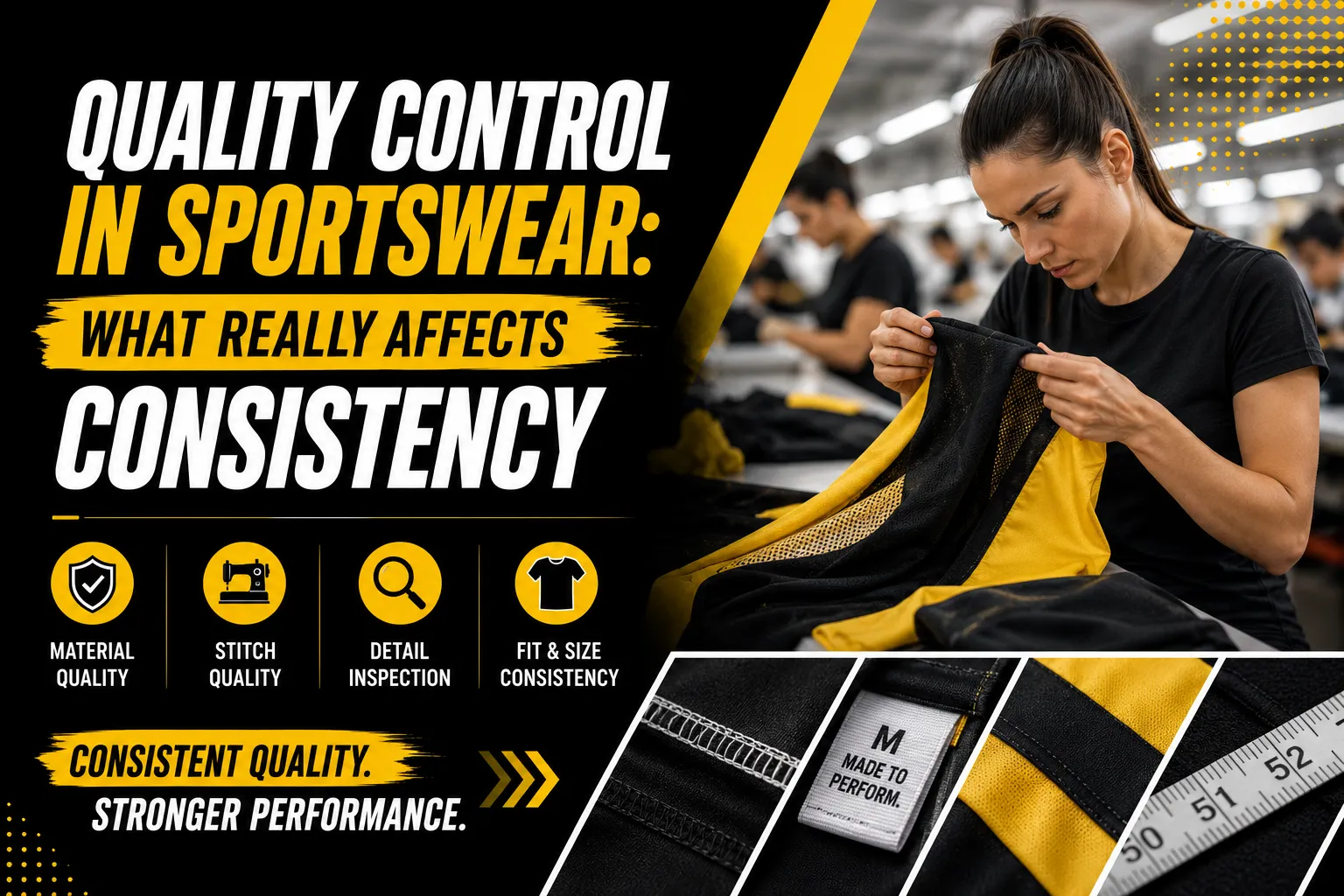
Why Consistency Is the Real Measure of Quality
When you place an order for sportswear, you don’t judge your supplier by how good the sample looks once you judge them by how consistently they can reproduce it across hundreds or thousands of pieces.
That is where most brands start facing problems.
A sample may look perfect, communication may feel smooth, and timelines may seem clear. But when bulk production arrives, small variations begin to appear slight differences in stitching, fabric feel, sizing, or finishing.
In sportswear, even minor inconsistencies become visible very quickly because these garments are used in movement, training, stretching, and repeated washing.
If your production is not stable, your brand does not feel stable in the market.
That is why quality control is not something that happens at the end of production. It is something that influences every single stage of manufacturing.
In this guide, you will understand what actually affects consistency in sportswear production and what you should evaluate before placing an order with any manufacturer.
Why Quality Consistency Matters More Than Perfect Design
A strong design can help you get your first sale, but consistency is what builds your brand.
If your customers order again and receive a slightly different version of the same product, trust starts to break. And in sportswear, trust is everything.
Here is how inconsistency typically impacts your brand:
| Area Affected | What Happens When Quality Is Not Consistent |
| Customer Experience | Product feels different from previous purchase |
| Brand Trust | Customers hesitate to reorder |
| Reviews | Increased complaints and negative feedback |
| Returns | Higher return and exchange rates |
| Scaling | Difficulty maintaining product standards |
Most brands don’t lose customers because of design issues they lose them because the second or third order doesn’t feel the same as the first.
What Most Brands Misunderstand About Quality Control
Many brands assume quality control is a final inspection step before shipping.
In reality, that is only one small part of the process.
Quality control is actually a system that runs through the entire production cycle. If any early stage is weak, the final inspection cannot fix it.
A simple way to understand this is:
Final inspection does not create quality. It only detects problems.
Real quality is built much earlier in the process.
Where Quality Issues Actually Begin in Sportswear Production
Most inconsistencies do not appear at the end of production. They start from a few specific points during manufacturing.
Understanding these helps you evaluate your supplier more effectively.
1. Fabric Variation
Fabric is the foundation of every sportswear product. Even small variations in fabric can change how a garment feels and performs.
| Fabric Issue | Impact on Final Product |
| GSM variation | Changes weight and comfort |
| Dye variation | Color mismatch across batches |
| Fabric substitution | Entire product feels different |
If fabric control is weak, no amount of stitching quality can compensate for it.
2. Weak Sampling Control
Your approved sample should act as the strict reference point for bulk production.
However, problems begin when:
- The sample is treated as a “reference” instead of a fixed standard
- Minor changes are made during production without approval
- Bulk teams interpret the sample differently than sampling teams
This is one of the most common reasons brands experience inconsistency between orders.
3. Cutting and Pattern Accuracy
Even when fabric is correct, cutting errors can affect sizing and fit.
Small deviations in pattern grading or cutting precision lead to:
- Size variation across units
- Fit differences between batches
- Misalignment in panels or seams
This becomes very noticeable in fitted products like Compression Wear or performance-based Activewear.
4. Stitching Stability
Stitching is where most visible quality differences appear.
| Stitching Issue | Effect on Product |
| Uneven tension | Loose or tight seams |
| Machine variation | Inconsistent finish |
| Poor supervision | Visible defects in bulk |
Sportswear requires stable stitching because garments go through stretching and movement. Any weakness becomes visible after use.
What Real Quality Control Actually Looks Like
In a properly managed sportswear production system, quality is not checked only at the end it is monitored throughout every stage.
A structured quality system usually includes:
- Fabric inspection before cutting
- Sample approval as a fixed production benchmark
- Inline checks during stitching
- Stage-wise supervision during assembly
- Final inspection before packing
Each step reduces the chance of errors reaching the next stage.
Why Sizing Consistency Is One of the Biggest Hidden Problems
One of the most overlooked areas in sportswear quality control is sizing stability. Many brands only realize this issue after repeat orders, when customers start noticing that the “same size” no longer fits the same way.
This usually happens because pattern control is not fully standardized during production.
Even a small deviation in grading or cutting can create noticeable differences across batches.
| Issue | Result for Your Brand |
| Pattern variation between batches | Fit feels different in repeat orders |
| Cutting inconsistency | Sizes run slightly larger or smaller |
| No standardized measurement checks | Customer confusion and returns |
| Weak sample benchmarking | Bulk does not match approved fit |
In sportswear, sizing is not just a technical detail. It is part of your brand identity. When sizing shifts, your entire product experience shifts with it.
Red Flags in a Manufacturer’s Quality Control System
If you want to avoid production issues, you need to identify weak systems before placing your order.
Here are clear warning signs that often indicate inconsistent quality control:
- Your sample looks different from bulk without explanation
- Fabric details are unclear or frequently changed
- There is no structured inspection process during production
- Communication happens only when problems appear
- Measurements are not verified at multiple stages
- You are not shown any quality checkpoints during production
These signs usually point to a reactive production system rather than a controlled one.
And in sportswear manufacturing, reactive systems almost always lead to inconsistency.
How Quality Control Directly Impacts Your Brand Growth
Quality control is not just a production concern it directly affects how your brand grows in the market.
When consistency is strong, your customers trust your products over time. They know that every purchase will feel the same in terms of fit, comfort, and performance.
When consistency is weak, your growth becomes unpredictable.
Here is how QC influences your brand performance:
| Area | Strong QC Impact | Weak QC Impact |
| Customer retention | Repeat purchases increase | Customers hesitate to reorder |
| Reviews | Stable positive feedback | Mixed or negative feedback |
| Scaling | Easier to expand product line | Difficult to maintain standards |
| Returns | Low return rate | Frequent size/quality returns |
| Brand reputation | Strong and reliable identity | Inconsistent market perception |
Your brand is not judged by your first product it is judged by your repeat consistency.
How Ethical Manufacturing and Quality Control Work Together
Quality control and ethical manufacturing are closely connected, even if they seem like separate topics.
When a manufacturer follows ethical production practices, quality naturally becomes more stable.
This is because ethical systems ensure:
- Transparent production stages instead of hidden processes
- Proper accountability at every step
- No unauthorized material substitutions
- Clear communication before changes are made
- Structured workflow instead of shortcuts
In simple terms, ethical manufacturing creates the environment where quality control actually works.
Without transparency, even strong QC systems lose effectiveness.
What You Should Expect From a Reliable Sportswear Manufacturer
Before placing your order, you should be confident that your manufacturer can maintain consistency across all stages of production.
A reliable partner will always provide:
- A sample that acts as a strict production reference
- Clear measurement and sizing standards
- Fabric consistency across all batches
- Multi-stage inspection instead of final-stage checking only
- Transparent communication during production
- Stability in repeat orders without unexpected changes
If these standards are not present, scaling your brand becomes difficult regardless of how strong your designs are.
How We Ensure Quality Consistency at Natural Grace Sports
At Natural Grace Sports, quality control is not treated as a final step it is built into every stage of production.
From the moment your sample is approved, it becomes the reference point for the entire production process. Every fabric check, cutting stage, stitching line, and finishing detail is aligned with that approved standard.
We focus on maintaining consistency across all orders, whether it is your first small batch or a scaled production run.
Our approach includes structured inspection points during production, controlled fabric sourcing, and continuous communication throughout the process.
The goal is simple: when your customer receives your product, it should reflect the same standard every single time.
Final Thoughts
Quality control is not about checking products at the end. It is about controlling the process from the beginning.
Most consistency problems in sportswear do not happen suddenly they start with small gaps in fabric control, sampling discipline, or production structure.
When you understand what actually affects quality, you make better decisions before placing your order. And those decisions directly shape how your customers experience your brand.
Strong sportswear brands are not built on one perfect order. They are built on consistent production, repeatable quality, and reliable manufacturing systems.
If you are planning your next sportswear collection and want a manufacturing partner that focuses on consistency, structure, and long-term brand growth, the right production system makes all the difference.


