
Industry Insights
Printing vs Embroidery: What Works Best for Sportswear?

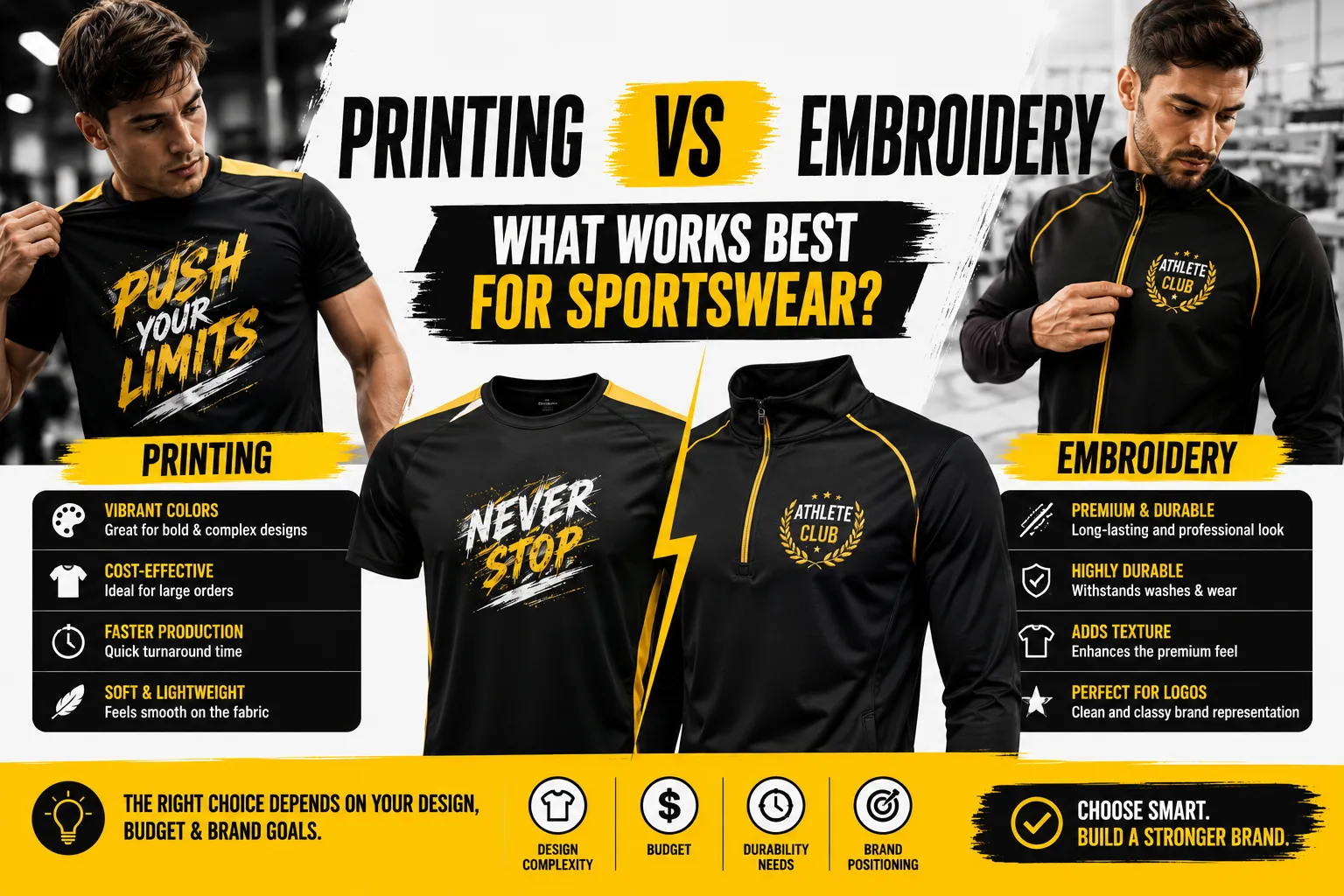
When you’re developing a custom sportswear collection, every detail matters. From fabric selection and garment fit to colors and packaging, each decision shapes how customers perceive your brand. One of the most important choices is how you apply your logo and branding.
Many brands assume embroidery always creates a premium look, while printing is simply the budget-friendly option. In reality, neither method is universally better. The right choice depends on the type of sportswear you’re producing, the fabric you’ve selected, how the garment will be used, your logo design, and the experience you want to deliver to your customers.
For example, the branding method that works perfectly on a heavyweight hoodie may not be suitable for a lightweight running shirt. Likewise, a logo designed for a fashion-focused streetwear collection may require a different approach than one intended for a high-performance compression garment.
Understanding these differences before production begins can help you avoid unnecessary costs, improve product quality, and create sportswear that aligns with your brand’s positioning.
In this guide, we’ll compare printing and embroidery, explain where each method performs best, and help you choose the right solution for your next sportswear collection.
Why Your Branding Method Matters More Than You Think
Your logo is often the first thing customers notice about your products. It represents your brand, communicates quality, and influences how your apparel is perceived long before someone wears it.
However, branding is about more than appearance.
The application method also affects how the garment feels, performs, and lasts over time. Sportswear is designed to move, stretch, wick moisture, and remain comfortable during physical activity. Choosing an unsuitable branding method can reduce comfort, affect flexibility, or shorten the lifespan of the garment.
As a sportswear manufacturer working with brands across different markets, we’ve found that successful products are rarely built by choosing the most expensive option. They’re built by selecting the branding method that matches the garment’s purpose.
When evaluating your options, consider questions such as:
- Will the garment be used for sports, fitness, or casual wear?
- Is the fabric lightweight, stretchy, or heavyweight?
- Does your logo include fine details or multiple colors?
- Are you creating a premium lifestyle collection or performance-focused apparel?
- What experience do you want your customers to have when wearing your products?
Answering these questions early helps you make informed production decisions and reduces the likelihood of costly changes later in the manufacturing process.
What Is Sportswear Printing?
Printing is the process of applying your logo, artwork, or graphics directly onto the surface of a garment using specialized printing techniques.
Rather than stitching thread into the fabric, printing creates a design that becomes part of the garment’s exterior appearance. Depending on the method used, prints can be smooth, textured, flexible, reflective, or even three-dimensional.
Today, sportswear manufacturers use several printing techniques, each designed for different products and branding requirements. Common options include screen printing, heat transfer printing, direct-to-film (DTF), silicone printing, puff printing, reflective printing, and sublimation printing for polyester garments.
The right method depends on factors such as fabric composition, design complexity, production quantity, and the intended use of the garment.
Why Printing Is Popular for Sportswear
Printing has become one of the most widely used branding methods because it offers excellent design flexibility.
It allows brands to reproduce detailed artwork, gradients, multiple colors, and large graphics with impressive accuracy. This makes it particularly suitable for modern activewear, team uniforms, gym apparel, and performance clothing where bold visual designs are often part of the brand identity.
Printing also preserves the natural flexibility of many performance fabrics when the appropriate technique is selected. This is especially important for garments designed for running, training, cycling, and other activities that involve continuous movement.
Sportswear Products That Commonly Use Printing
Printing is frequently chosen for products such as:
| Sportswear Product | Why Printing Works Well |
| Performance T-shirts | Maintains flexibility while supporting detailed logos and graphics. |
| Team Jerseys | Ideal for player names, numbers, sponsors, and vibrant designs. |
| Running Shirts | Lightweight application suitable for breathable fabrics. |
| Compression Wear | Preserves stretch and minimizes bulk. |
| Leggings | Supports clean branding without affecting comfort. |
| Rash Guards | Works well with high-stretch performance fabrics. |
Choosing the correct printing method is just as important as deciding to print in the first place. Different fabrics respond differently to heat, pressure, inks, and production techniques, which is why experienced manufacturing guidance is valuable during product development.
What Is Embroidery?
Embroidery is the process of stitching your logo or design directly into the fabric using high-quality threads.
Unlike printing, embroidery creates a raised, textured finish that adds depth and dimension to the garment. It has long been associated with premium apparel because of its clean appearance and professional presentation.
However, embroidery is not automatically the best choice for every sportswear product.
Its suitability depends largely on the garment’s construction, fabric weight, intended use, and logo design.
Why Many Brands Choose Embroidery
Embroidery offers a distinctive finish that can elevate the perceived value of a product.
For lifestyle apparel, teamwear, corporate sportswear, and premium collections, embroidered logos often create a polished appearance that aligns with a high-end brand image.
The stitched threads also maintain their appearance through regular wear when applied to suitable fabrics, making embroidery a reliable choice for garments that aren’t subjected to extreme stretching during use.
Sportswear Products That Commonly Use Embroidery
Embroidery is typically recommended for products such as:
| Sportswear Product | Why Embroidery Works Well |
| Hoodies | Heavy fabrics provide excellent support for stitched logos. |
| Sweatshirts | Creates a premium, textured finish. |
| Polo Shirts | A classic choice for clean and professional branding. |
| Jackets | Durable fabrics hold embroidery exceptionally well. |
| Tracksuits | Suitable for premium collections and team apparel. |
| Caps | Embroidery delivers a structured, long-lasting logo. |
While embroidery creates a premium appearance, it may not always be the right solution for lightweight performance garments. Fabrics designed for maximum stretch, moisture management, and athletic movement often require branding methods that preserve those performance characteristics.
This is why experienced manufacturers evaluate the complete product not just the logo before recommending a branding method.
Printing or Embroidery: Which One Is Right for Your Brand?
There isn’t a universal answer because every sportswear collection has different goals.
The best choice depends on how your products will be worn, the fabrics you’ve selected, the complexity of your logo, your target market, and the overall identity of your brand.
In the next section, we’ll compare printing and embroidery side by side, examine how each performs on different fabrics, discuss cost considerations, durability, and common mistakes brands should avoid before placing a production order.
Printing vs Embroidery: Side-by-Side Comparison
Both printing and embroidery have their strengths. Instead of asking which method is better, the more practical question is which one is better for your specific product.
The table below compares the two across the factors that matter most when developing a sportswear collection.
| Factor | Printing | Embroidery |
| Appearance | Smooth, modern, and ideal for detailed graphics | Textured, raised, and premium-looking |
| Best for Logo Size | Small, medium, or large designs | Small to medium logos |
| Design Complexity | Excellent for intricate details and multiple colors | Best for simpler designs with clean outlines |
| Comfort | Lightweight with minimal bulk | Slightly heavier due to stitched threads |
| Stretch Performance | Better suited for stretch fabrics when the correct method is used | Less suitable for highly stretchable garments |
| Breathability | Maintains the fabric’s natural feel in most applications | May slightly reduce breathability around the embroidered area |
| Fabric Compatibility | Works well on many sportswear fabrics with the right printing technique | Best for medium to heavyweight fabrics |
| Cost Factors | Influenced by print size, colors, method, and quantity | Influenced by stitch count, logo size, and placement |
| Best Applications | Jerseys, gym wear, running apparel, compression wear, leggings | Hoodies, polo shirts, jackets, caps, and tracksuits |
The right choice isn’t about following trends. It’s about selecting the branding method that complements your product instead of working against it.
Which Fabrics Work Best with Printing?
Modern sportswear is manufactured using a wide range of technical fabrics, and each behaves differently during production. Choosing the appropriate printing method helps maintain the garment’s appearance and performance.
| Fabric | Why Printing Is a Good Choice |
| Polyester | Excellent for vibrant graphics and teamwear, particularly with sublimation. |
| Polyester-Spandex Blends | Maintains flexibility for activewear and compression garments. |
| Cotton | Produces clean logos and graphics with several printing methods. |
| Cotton Blends | Balances comfort with durable branding. |
| Performance Knits | Suitable for lightweight athletic apparel when the correct technique is selected. |
Performance garments are designed to stretch, breathe, and move with the athlete. A suitable print method supports these characteristics instead of restricting them.
Which Fabrics Are Better for Embroidery?
Embroidery performs best when the fabric provides enough stability to support stitched designs.
| Fabric | Suitability for Embroidery |
| Fleece | Excellent |
| French Terry | Excellent |
| Heavyweight Cotton | Excellent |
| Hooded Sweatshirt Fabrics | Excellent |
| Softshell Fabrics | Very Good |
| Lightweight Compression Fabrics | Generally not recommended |
| Ultra-Light Running Fabrics | Usually not the best choice |
This doesn’t mean embroidery cannot be applied to lightweight fabrics. However, doing so without considering the garment’s purpose may affect comfort, flexibility, or the overall finish.
How Cost Differs Between Printing and Embroidery
Many buyers ask which option is more affordable, but there isn’t a fixed answer.
The total cost depends on the design and the garment rather than the branding method alone.
Printing costs are commonly influenced by:
- Logo size
- Number of print colors
- Printing technique
- Order quantity
- Print placement
Embroidery costs are generally affected by:
- Stitch count
- Logo dimensions
- Thread colors
- Number of embroidery locations
- Garment construction
For example, a small embroidered chest logo on a hoodie may cost less than producing a large multi-color back print. On the other hand, printing is often the more economical choice for oversized graphics or highly detailed artwork.
Looking beyond the initial production cost is equally important. Your branding method should support your product’s value, customer expectations, and long-term brand positioning.
Which Option Lasts Longer?
Both printing and embroidery can provide excellent durability when the correct application method is matched with the right fabric.
Embroidery is known for maintaining its textured appearance over time on suitable garments such as hoodies, jackets, and polo shirts.
Printing has also advanced significantly. High-quality printing techniques can withstand repeated washing, regular training sessions, and everyday wear while maintaining sharp graphics and vibrant colors.
Rather than asking which method lasts longer, ask whether the chosen branding method is appropriate for the garment you’re producing.
A premium running shirt and a heavyweight hoodie serve different purposes, so they shouldn’t automatically receive the same type of branding.
Can You Combine Printing and Embroidery?
Absolutely.
Many successful sportswear brands combine both techniques to create products with a distinctive appearance.
Some common examples include:
- An embroidered chest logo with a printed back graphic.
- Embroidered branding paired with printed sleeve graphics.
- A printed performance jersey with embroidered sponsor patches where appropriate.
- A premium tracksuit featuring an embroidered logo and printed design accents.
Combining branding methods can help create products that stand out while maintaining comfort and functionality. The key is ensuring each application complements the garment rather than competing with it.
Common Mistakes Brands Should Avoid
After working with brands developing custom sportswear collections for different markets, we’ve noticed several recurring mistakes that can easily be avoided with proper planning.
Choosing based only on price
The cheapest option isn’t always the best investment if it doesn’t suit your product.
Ignoring the fabric
Branding should always be selected after considering the fabric’s weight, stretch, and intended use.
Using embroidery on highly stretchable performance garments
While embroidery looks premium, it isn’t always the most comfortable solution for garments designed for unrestricted movement.
Using oversized embroidered logos
Large embroidered areas can add unnecessary weight and stiffness to apparel.
Selecting printing without considering garment purpose
Different printing techniques are designed for different fabrics and performance requirements.
Overlooking future brand growth
A branding method that works for your first collection should also support consistency as your product range expands.
How We Help You Choose the Right Branding Method
At Natural Grace Sports, we believe successful manufacturing begins long before production starts.
Instead of recommending the same solution for every project, we evaluate your collection as a whole. We consider your garment type, fabric selection, logo artwork, target market, and brand positioning before suggesting the most suitable branding method.
Whether you’re launching a new activewear brand, expanding your gym wear collection, producing team uniforms, or developing premium lifestyle apparel, our goal is to help you create products that look professional, perform as intended, and reflect the quality your customers expect.
By combining manufacturing experience with a practical understanding of sportswear performance, we help you make informed production decisions that support both product quality and long-term brand growth.
Frequently Asked Questions
Not necessarily. Embroidery creates a textured, premium appearance on many garments, but high-quality printing can deliver an equally professional finish, especially on modern performance sportswear.
Most gym apparel benefits from suitable printing methods because they preserve flexibility, comfort, and lightweight performance.
In many cases, printing is a better choice for compression garments because it maintains stretch and reduces bulk.
This depends on the design, but printing is widely used for player names, numbers, sponsors, and full-color graphics on performance jerseys.
Yes. Combining both methods is common and can create a distinctive, premium product when planned correctly.
Final Thoughts
Choosing between printing and embroidery isn’t about finding a single winner. It’s about selecting the branding method that supports your product, your customers, and your brand identity.
A lightweight running shirt, a compression top, and a heavyweight hoodie all serve different purposes, so they deserve branding solutions that match their performance and appearance.
Taking the time to evaluate your fabrics, logo design, intended use, and customer expectations before production begins will help you create sportswear that performs well and represents your brand with confidence.
If you’re planning your next custom sportswear collection and need guidance on branding methods, fabric selection, or manufacturing, we’re here to help. We’ll work with you to recommend the most suitable solution for your products, ensuring every detail supports the quality and performance your customers expect.


