
Industry Insights
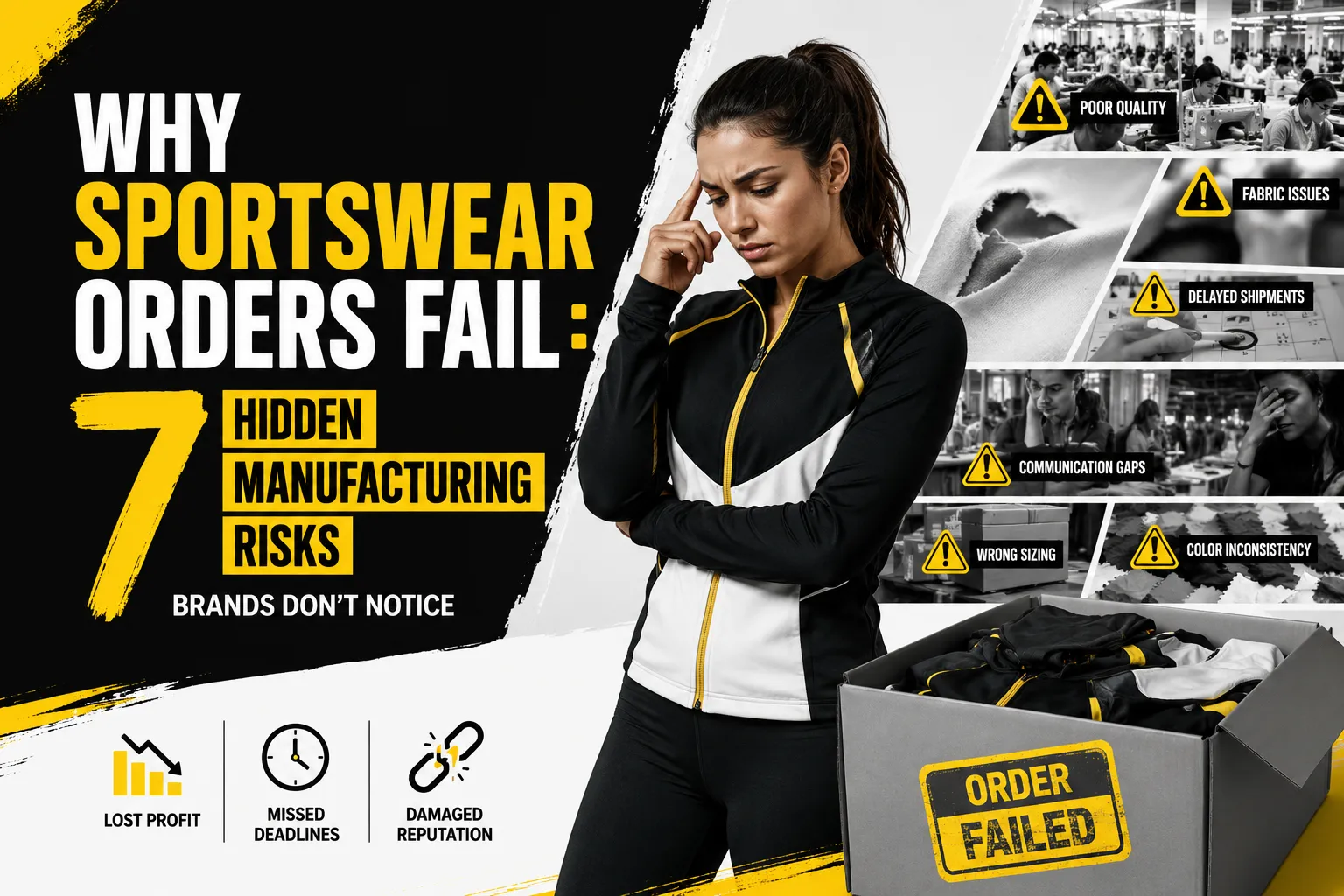
Why Sportswear Orders Fail: 7 Hidden Manufacturing Risks Brands Don’t Notice

Why a “Good Sample” Doesn’t Always Mean a Good Order
When you are starting or scaling a sportswear brand, the sample stage often feels like the final confirmation point.
You check the fabric. You check the stitching. You approve the fit. Everything looks good. The supplier also sounds confident.
At that moment, it feels like the hard part is done.
But once bulk production starts, many brands experience a very different reality. The products don’t feel exactly the same. Sizes vary slightly. Fabric feels a bit different. Stitching is not as clean as the sample. Delivery takes longer than expected.
This is where confusion starts.
The important thing to understand is simple:
A sample is made in controlled conditions. Bulk production is not.
During sampling, everything is handled carefully, often by one experienced person or a small team. During bulk production, multiple operators, different batches of fabric, time pressure, and production speed all start affecting consistency.
So the real issue is not the sample quality. The real issue is whether that quality can be repeated at scale without changes.
Most sportswear order failures happen because brands assume consistency will automatically continue after sampling. In reality, consistency has to be controlled at every stage.
This guide explains the hidden risks that quietly affect sportswear orders and how they impact your final product.
Why Sportswear Orders Fail Even When the Supplier Looks Reliable
Many brands believe that if communication is smooth and samples look good, the supplier must be reliable.
But manufacturing does not work on first impressions.
There is a big difference between discussing a product and producing it in bulk. During discussions, everything sounds flexible and easy. During production, real limitations appear such as fabric availability, machine capacity, operator skill differences, and time pressure.
This gap between “what was promised” and “what is actually produced” is where most issues begin.
To understand it simply:
| Stage | What It Looks Like |
| Sampling Stage | Controlled, slow, detailed, focused on perfection |
| Bulk Production | Fast, multi-step, influenced by time and resources |
Because of this difference, even a good sample can turn into inconsistent bulk production if systems are not properly controlled.
Risk #1: Fabric Changes That You Don’t Notice Immediately
Fabric is the most important part of any sportswear product. It affects comfort, stretch, durability, and overall feel.
One of the most common hidden issues in production is fabric variation. This does not always mean completely different fabric. Sometimes the change is very small and difficult to notice at first.
For example:
- Slight difference in thickness
- Minor change in stretch level
- Different dye batch
- Alternative supplier material
Individually, these changes may look small. But once the product is worn, washed, and used in training, the difference becomes noticeable.
| Expected Fabric | What Can Actually Happen |
| Same softness | Slightly different texture |
| Same color shade | Small variation in tone |
| Same stretch level | Slight stiffness or looseness |
When fabric is not strictly controlled, your product no longer feels consistent across orders.
Risk #2: Sample Is Not Treated as a Strict Production Standard
One major misunderstanding in manufacturing is thinking that once a sample is approved, it automatically becomes the final reference.
In reality, not every factory treats samples as strict production benchmarks.
Problems start when:
- Sample is seen as “reference” instead of “standard”
- Different teams handle sampling and bulk production
- Small changes are made without informing you
- Fabric or trims are adjusted for availability
This leads to a situation where the bulk production looks similar but is not exactly the same.
Over time, this small gap becomes a bigger problem for your brand consistency.
Risk #3: Size and Fit Variation in Bulk Production
Even if the fabric is correct and the sample looks perfect, sizing issues can still appear in bulk production.
This usually happens due to pattern grading and cutting differences.
In simple terms, pattern grading is the process of scaling sizes like small, medium, large, and extra large. If this is not done carefully, each size may not follow the exact proportion.
Common issues include:
- Medium size slightly larger than sample
- Small size tighter than expected
- Inconsistent length across batches
- Left and right panels not matching perfectly
| Issue | Customer Experience |
| Size variation | “This doesn’t fit like before” |
| Poor grading | “Sizing feels inconsistent” |
| Cutting errors | “Fit looks uneven” |
In sportswear, even small sizing changes affect performance and comfort.
Risk #4: Stitching Differences Between Units
Stitching is one of the most visible parts of sportswear quality.
In bulk production, multiple operators handle stitching. Even if they are skilled, slight differences in technique can appear.
This leads to:
- Slightly different seam tightness
- Minor variations in finishing
- Loose threads in some units
- Uneven stitch alignment
These differences may not be visible in one piece, but they become clear when you compare multiple units from the same order.
For performance wear, stitching consistency is especially important because garments are stretched and used under pressure.
Risk #5: Quality Is Checked Only at the End of Production
Many suppliers rely only on final inspection before packing.
This is risky because by the time issues are found, the entire order is already completed.
A proper quality system checks production at multiple stages:
- Fabric inspection before cutting
- Checking during stitching
- Size verification during production
- Final inspection before packing
| QC Approach | Result |
| Only final check | Higher chance of defects reaching shipment |
| Stage-wise checks | Controlled and stable production |
Without stage-wise control, small mistakes become large batch problems.
Risk #6: Communication Breaks During Production
Communication is usually strong before you confirm an order. But once production starts, updates often become less frequent.
This creates uncertainty.
Common problems include:
- No regular progress updates
- Issues reported too late
- Instructions misunderstood during production
- Delays not communicated early
When communication is weak, small issues turn into bigger delays because they are not addressed in time.
| Communication Level | Production Outcome |
| Clear and regular updates | Smooth production flow |
| Irregular communication | Confusion and delays |
| No updates | Hidden production problems |
Good communication keeps production under control.
Risk #7: Unrealistic Timelines That Lead to Rushed Production
Many suppliers promise fast delivery to win orders. While this sounds attractive, production has natural limitations.
These include:
- Fabric sourcing time
- Cutting and stitching capacity
- Quality control requirements
- Packing and logistics preparation
When timelines are unrealistic, something usually gets compromised.
Most of the time, it is quality.
| Promised Timeline | Real Outcome |
| Very fast delivery | Production pressure increases |
| High pressure | Less attention to detail |
| Less control | Inconsistent final product |
A realistic timeline is always better than a rushed promise.
How These Hidden Risks Affect Your Brand
These issues do not stay inside the factory. They directly affect your brand in the market.
You may experience:
- Customers receiving different quality in repeat orders
- Increased returns due to sizing or fabric issues
- Negative feedback affecting brand reputation
- Difficulty scaling product lines
- Loss of trust in your brand consistency
Most brands do not fail because of design. They fail because production consistency breaks over time.
How Reliable Manufacturers Prevent These Problems
Strong manufacturers reduce these risks through structured systems.
They ensure:
- Sample is locked as final production standard
- Fabric is approved and controlled before production
- Production is monitored step by step
- Communication stays active throughout
- Quality is checked during the entire process
This creates stability instead of uncertainty.
How We Handle This at Natural Grace Sports
At Natural Grace Sports, we focus on controlling production from the beginning to the end.
We ensure:
- Clear sample-to-bulk matching without changes
- Fabric verification before production starts
- Stage-wise quality checks during production
- Transparent communication at every step
- Consistent output for repeat orders
Our focus is simple: your customer should receive the same quality every time, not just the first time.
Conclusion: Hidden Risks Decide Your Real Production Outcome
Sportswear order failures rarely happen because of one big mistake. They happen because of small hidden risks that are not controlled properly.
Once production starts, these small gaps turn into visible differences in quality, fit, and consistency.
Understanding these risks before placing your order helps you avoid costly mistakes and build a more stable brand.
A strong manufacturer removes uncertainty. A weak one creates it.
And in sportswear manufacturing, consistency is what defines your brand more than anything else.


