
Industry Insights
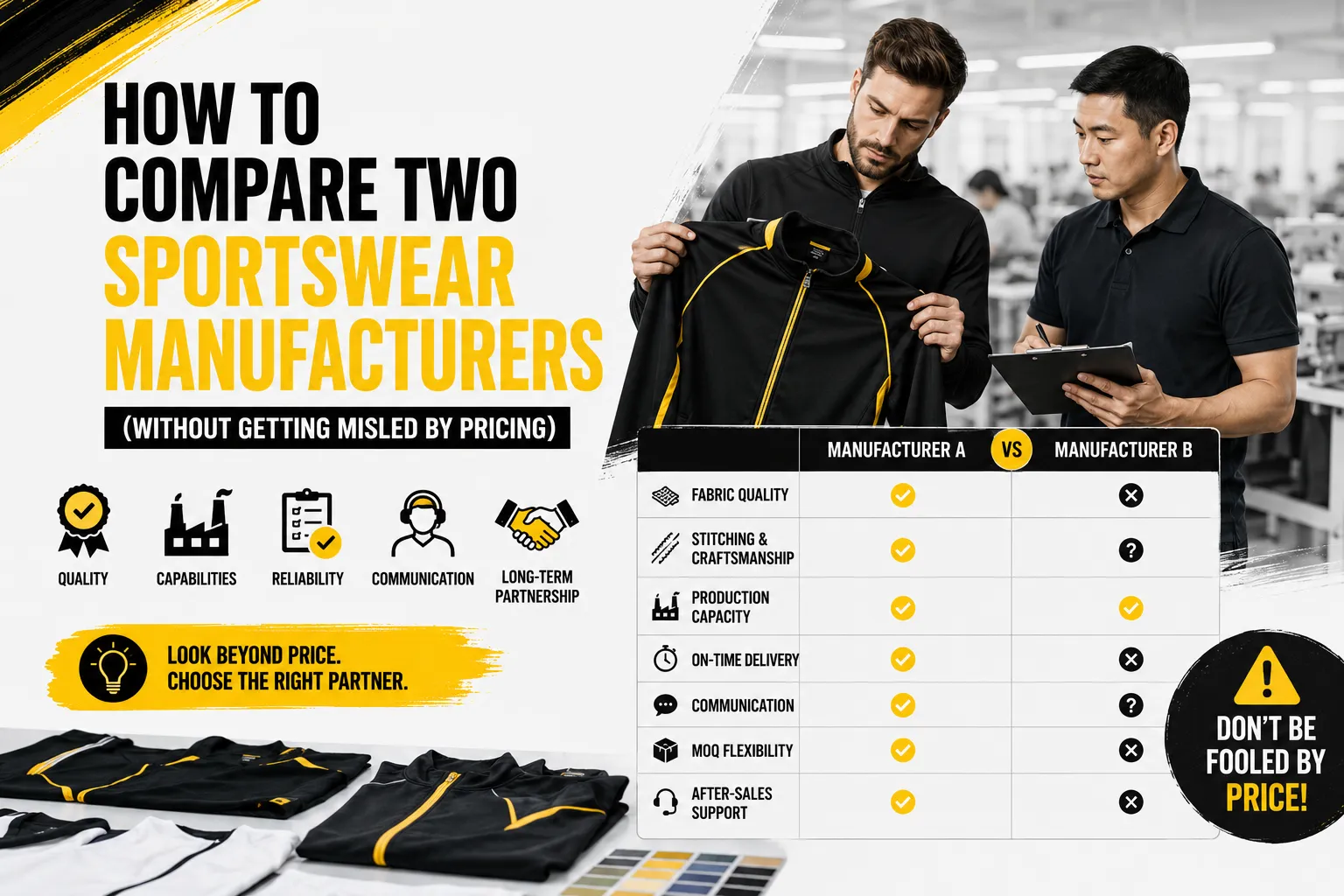
How to Compare Two Sportswear Manufacturers (Without Getting Misled by Pricing)

Why This Decision Is Bigger Than Just Price
When you are choosing between two sportswear manufacturers, it often feels like a simple comparison exercise.
You check prices. You compare samples. You look at delivery timelines. Both options may look similar on the surface.
But in reality, this is one of the most critical decisions for your brand.
Because you are not just selecting a supplier you are selecting the system that will produce your products, represent your brand quality, and directly affect your customer experience.
Most brands make the mistake of focusing heavily on price differences at this stage. A slightly cheaper option often feels attractive. But what is not visible at this point is the production stability behind that price.
A lower price does not automatically mean better value. In many cases, it simply means less control, fewer checks, or weaker systems behind production.
This guide will help you compare two manufacturers in a practical, real-world way so you can choose based on long-term reliability not just short-term cost.
Why Price Alone Is a Misleading Comparison Factor
Price is the easiest thing to compare, but it is also the least reliable indicator of manufacturing quality.
Two manufacturers can quote very different prices for the same product, but the difference is usually not just profit margin. It comes from what is included in the production system.
For example:
- One supplier may include proper quality control stages
- Another may only inspect at the end
- One may use consistent fabric sourcing
- Another may switch based on availability
- One may have structured production flow
- Another may operate more manually without strict systems
So when you compare price alone, you are not seeing the full picture.
| Low Price Supplier | Structured Supplier |
| Limited QC steps | Multi-stage QC system |
| Flexible fabric sourcing | Controlled fabric system |
| Fast but unstable production | Balanced production flow |
| Higher risk of variation | Stable consistency |
A small price difference often reflects a much bigger difference in production reliability.
What You Are Actually Comparing Between Two Manufacturers
To make a correct decision, you need to stop comparing “prices” and start comparing “systems.”
A sportswear manufacturer is not just a factory. It is a combination of:
- Fabric control system
- Sampling process
- Production workflow
- Quality control structure
- Communication system
- Scaling capacity
When you compare two suppliers, you are really comparing how strong or weak these systems are.
If you only compare surface-level details, you miss the real production reality.
1. Sample Quality vs Bulk Production Capability
Most brands make decisions based on samples. But sample quality alone is not enough.
The real question is:
Can this sample quality be repeated in bulk production consistently?
A sample is usually made under controlled conditions. Bulk production is not.
Key things to compare:
- Is the sample treated as a strict production reference?
- Or just a “close guide”?
- Does bulk production match samples exactly?
- Are different teams involved in sample and bulk?
| Factor | Manufacturer A | Manufacturer B |
| Sample accuracy | High | High |
| Bulk consistency | Unclear | Proven |
| Production alignment | Weak | Structured |
If one manufacturer cannot guarantee sample-to-bulk consistency, that is a major risk for your brand.
Internal link:
👉 Choosing the Right Sportswear Manufacturer for Your Brand
2. Fabric Control and Stability
Fabric is one of the biggest hidden differences between manufacturers.
Even if two suppliers claim to use the same fabric, the actual result can be different in bulk production.
You should compare:
- Who sources the fabric
- Whether fabric is approved before production
- Whether GSM and composition are fixed
- Whether fabric changes between orders
What usually goes wrong:
| Fabric Area | Risk Impact |
| GSM variation | Product feels different |
| Dye inconsistency | Color mismatch |
| Fabric substitution | Quality drop without notice |
A strong manufacturer always locks fabric standards before production begins.
Internal link:
👉 Choosing the Right Fabric for Gym & Activewear
3. Production System Strength
This is where long-term stability is decided.
A weak production system relies heavily on manual coordination and flexibility. A strong system follows structured steps.
You should compare:
- Do they follow a fixed workflow?
- Is production step-by-step or flexible?
- Are responsibilities clearly defined?
- Is progress trackable?
| System Type | Result |
| Structured system | Predictable output |
| Flexible system | Risk of variation |
A structured system always produces more stable results, especially at scale.
4. Quality Control Depth
Quality control is one of the most important comparison points, but many brands misunderstand it.
They assume QC means final inspection. In reality, that is only one part.
You should check:
- Is QC only at the final stage?
- Or is it done throughout production?
- Are defects checked during stitching?
- Is fabric inspected before cutting?
| QC Approach | Outcome |
| Final inspection only | Higher defect risk |
| Multi-stage QC | Stable quality |
Internal link:
👉 Quality Control in Sportswear: What Really Affects Consistency
5. Communication and Transparency
Communication is often ignored during comparison, but it becomes one of the biggest factors during production.
A good manufacturer:
- Explains clearly
- Responds with technical clarity
- Updates regularly
- Shares issues early
A weak manufacturer:
- Gives vague answers
- Avoids technical details
- Communicates only when asked
- Delays updates
Clear communication reduces production risk significantly.
6. Pricing Structure Transparency
Instead of asking “who is cheaper,” you should ask:
“What exactly am I paying for?”
A clear pricing structure should include:
- Fabric cost
- Stitching cost
- Trims and accessories
- Packaging
- Sampling charges
Comparison insight:
| Pricing Type | Risk Level |
| Fully transparent | Low risk |
| Unclear breakdown | High risk |
Hidden costs often appear later in production when clarity is missing at the start.
7. Scalability and Long-Term Production Capacity
A manufacturer may handle small orders well but struggle when your brand grows.
You should compare:
- Can they repeat quality at larger volumes?
- Can they maintain consistency across batches?
- Do they have capacity for scaling?
- Is their system designed for growth?
A strong manufacturer does not just handle today’s order they support your future growth.
Common Mistakes Brands Make While Comparing Manufacturers
Many brands make predictable mistakes during comparison:
- Choosing based only on price
- Ignoring communication quality
- Not testing sample-to-bulk consistency
- Overlooking fabric control systems
- Assuming all factories work the same way
These mistakes often lead to inconsistent production later.
Red Flags When Comparing Two Manufacturers
If you notice the following, it usually indicates risk:
- One supplier avoids technical explanations
- One cannot clearly describe QC process
- One changes fabric details during discussion
- One focuses only on pricing advantage
- One is unclear about production workflow
A strong manufacturer is always transparent about process, not just price.
Simple Comparison Framework (Decision Table)
| Factor | Manufacturer A | Manufacturer B |
| Sample consistency | ||
| Fabric control | ||
| Production system | ||
| Quality control | ||
| Communication | ||
| Scalability | ||
| Pricing transparency |
This table helps you make a structured decision instead of an emotional or price-driven one.
Why the Cheaper Option Often Becomes More Expensive Later
Lower prices often look attractive at the start. But hidden costs appear during production and after delivery.
These include:
- Reproduction costs
- Customer complaints
- Returns and refunds
- Lost sales
- Brand reputation damage
| Short-term saving | Long-term impact |
| Lower unit price | Higher correction cost |
| Fast decision | Production risk |
| Immediate benefit | Long-term loss |
Real manufacturing cost is not just production cost it is consistency cost.
How We Help Brands Compare Properly at Natural Grace Sports
At Natural Grace Sports, we understand that choosing between manufacturers is not easy.
That is why we focus on clarity before production begins.
We ensure:
- Sample is treated as final production benchmark
- Fabric is clearly defined and controlled
- Production workflow is structured and transparent
- Quality is checked at multiple stages
- Communication stays consistent throughout the process
Our goal is simple:
Help brands make confident production decisions based on clarity, not confusion.
Conclusion: Systems Decide Outcomes, Not Prices
When comparing two sportswear manufacturers, the biggest mistake is assuming that price difference reflects quality difference.
In reality, what matters most is the strength of the production system behind the price.
A structured system gives you consistency. A weak system creates risk.
And in sportswear manufacturing, consistency is what builds your brand not just the first order, but every order after that.
The right decision is not about choosing the cheapest supplier. It is about choosing the most reliable production system for your brand’s future.


