
Industry Insights
Scaling a Sportswear Brand Without Manufacturing Bottlenecks

1. Introduction: Why Most Sportswear Brands Struggle to Scale
In the sportswear industry, growth usually looks exciting from the outside. Orders increase, ads start performing, and more customers begin trusting the brand. But behind the scenes, something very different happens.
Production starts falling behind.
Deliveries get delayed. Best-selling products go out of stock. Customers start complaining. And suddenly, instead of scaling, the brand is constantly trying to “catch up.”
From a manufacturing point of view, this is extremely common. The issue is not demand. The issue is that most brands scale their sales faster than their production system can handle.
Scaling a sportswear brand is not about producing more products in panic mode. It is about building a production system that can grow in a controlled, stable, and predictable way without interruptions.
If the manufacturing side is not structured properly, even the strongest marketing strategy will fail to deliver results.
2. Understanding Manufacturing Bottlenecks in Simple Terms
A manufacturing bottleneck is any stage in production that slows down the entire workflow.
Think of sportswear production like a chain. If one link is weak or slow, the entire chain stops working smoothly.
Where bottlenecks usually happen:
| Production Stage | What Goes Wrong | Impact |
| Fabric sourcing | Delay in material arrival | Entire order gets pushed back |
| Sampling | Multiple revisions or unclear specs | Production cannot start |
| Cutting process | Limited capacity | Work piles up |
| Stitching line | Overloaded machines | Delayed output |
| Printing/embroidery | Queue backlog | Partial order completion |
| Quality control | Slow inspection process | Shipment delay |
| Packaging & shipping | Documentation or logistics delay | Late delivery to customer |
Simple explanation:
Even if 90% of production is complete, the slowest stage controls the delivery timeline.
That is the core problem brands face when scaling.
3. Why Sportswear Brands Get Stuck at Small Scale
Most brands assume scaling is a marketing challenge. In reality, it is a production discipline challenge.
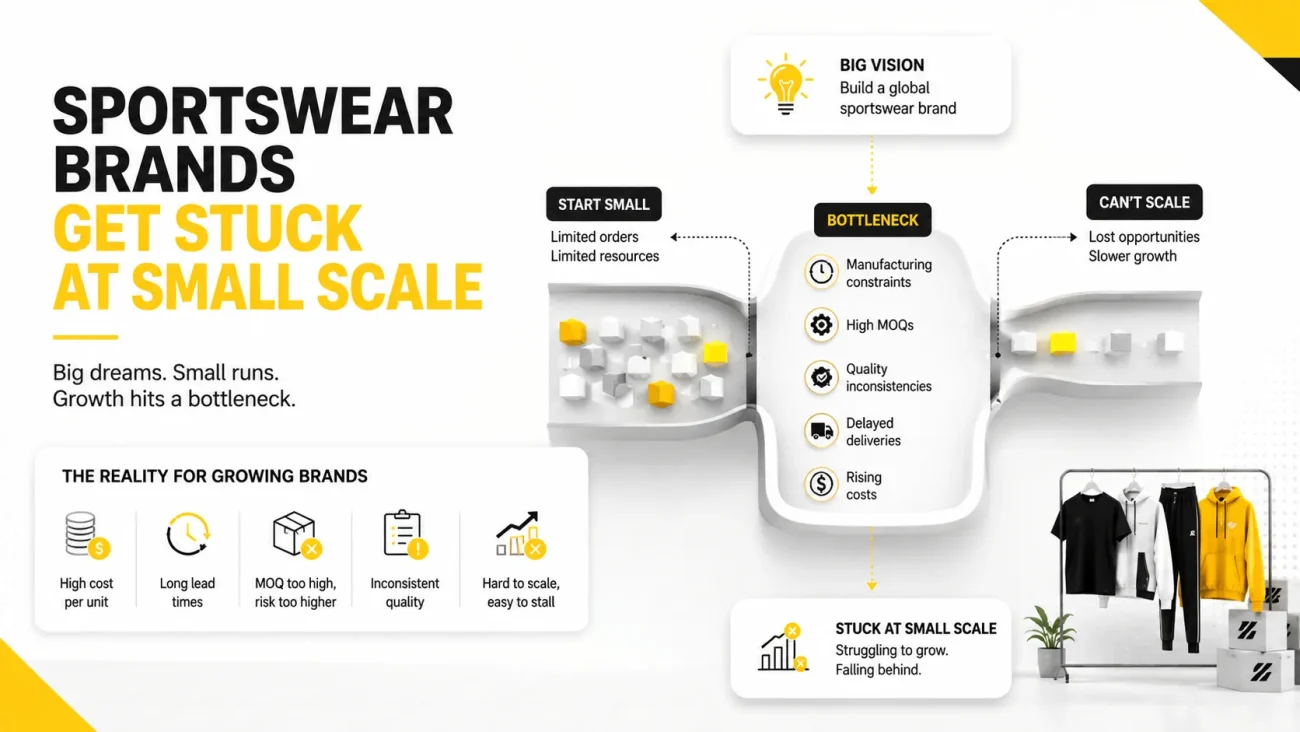
The most common real-world reasons:
1. Single supplier dependency
When everything depends on one factory or one supplier, any delay immediately stops growth.
2. No production forecasting
Orders are placed only when stock finishes, instead of being planned ahead.
3. Misunderstanding lead times
Many brands assume production works like retail. In manufacturing, everything follows structured timelines.
4. Constant design changes
Changing designs during production causes rework, wasted time, and material loss.
5. No structured production calendar
Without a schedule, everything becomes urgent. Urgency reduces efficiency.
Manufacturing reality:
Small brands react to demand. Scalable brands prepare for demand.
4. How Manufacturing Bottlenecks Affect Brand Growth
When production slows down, the damage is not limited to operations it directly affects revenue and brand perception.
Real impact of bottlenecks:
| Area | What Happens | Business Impact |
| Sales | Stock runs out | Lost revenue opportunities |
| Marketing | Ads keep running without inventory | Wasted ad spend |
| Customers | Delayed orders | Reduced trust |
| Brand image | Inconsistent availability | Weak market positioning |
| Cash flow | Irregular product availability | Financial instability |
Simple truth:
A delay of even 2 – 3 weeks in production can disrupt an entire sales cycle.
5. Smart Production Planning for Scaling Sportswear Brands
To scale properly, production must move from reactive to predictive.
5.1 Demand-Based Production Planning (How experienced brands do it)
Instead of waiting for orders, successful brands plan ahead based on data.
How to apply it practically:
- Analyze previous 2 – 3 months sales
- Identify consistent best-selling products
- Estimate upcoming demand cycles
- Pre-book production capacity with manufacturer
- Keep buffer timelines for unexpected spikes
Manufacturing insight:
Factories always prioritize planned production over urgent requests.
5.2 Batch Production Strategy (Reducing Risk While Scaling)
Producing everything at once is risky, especially for growing brands.
Smarter approach:
| Batch Stage | Purpose | Outcome |
| First batch | Market testing | Validate demand |
| Second batch | Scaling winners | Increase production volume |
| Third batch | Optimization | Improve cost and efficiency |
Why this works:
You avoid overproduction, reduce risk, and scale only what actually sells.
5.3 Product Prioritization System (Focus on what works)
Not every product deserves equal production attention.
How experienced manufacturers guide brands:
- Identify top-performing SKUs
- Prioritize production for high-demand products
- Reduce or pause slow-moving designs
- Continuously update based on sales data
Manufacturing principle:
Focus creates efficiency. Too many variations create delays.
6. Choosing a Manufacturing Partner That Supports Growth
From manufacturing experience, this is one of the most important decisions for scaling brands.
A manufacturer is not just a supplier. It is a production partner that either supports your growth or limits it.

Key capabilities of a scalable manufacturer:
| Capability | Why it matters |
| Flexible MOQ | Allows testing and scaling gradually |
| Fast sampling | Reduces time to market |
| High production capacity | Supports bulk scaling |
| Clear communication | Prevents misunderstandings |
| Export readiness | Enables global expansion |
| Consistent quality control | Maintains brand reputation |
Critical insight:
Even a strong brand cannot scale with a weak production partner.
7. How OEM and Private Label Manufacturing Supports Scaling
OEM and private label systems are designed for brands that want to grow without building their own factories.
How OEM works in simple terms:
You bring the idea and branding. The manufacturer handles everything else including sourcing, production, and finishing.
Why this model supports scaling:
- No need for internal production setup
- Faster development of new products
- Easier expansion of collections
- Controlled production costs
- Stable quality across batches
Private label advantage:
It allows brands to launch new collections quickly without production infrastructure delays.
8. Inventory Management Strategies (Often Ignored but Critical)
Even with strong manufacturing, poor inventory planning can still create bottlenecks.
Practical inventory strategies used by scaling brands:
| Strategy | How it works | Benefit |
| Safety stock | Extra inventory of best sellers | Prevents stockouts |
| Rolling production | Continuous small production cycles | Smooth supply flow |
| Pre-booked production slots | Reserved factory time | Priority production |
| Seasonal forecasting | Planning based on demand cycles | Better alignment with sales |
Manufacturing truth:
Inventory should always be ahead of demand, not reacting to it.
9. Scaling Without Losing Operational Control
As production grows, complexity increases. Without structure, operations become difficult to manage.
How experienced brands maintain control:
- Standardize tech packs before production
- Fix fabric options instead of constant changes
- Maintain consistent sizing charts
- Limit unnecessary product variations
- Centralize communication with manufacturer
Manufacturing insight:
The more standardized your process, the easier scaling becomes.
10. Common Mistakes That Block Scaling
These are the most common issues we see in growing sportswear brands:
- Scaling production without confirmed demand
- Ignoring factory capacity limitations
- Frequent last-minute design changes
- Poor seasonal planning
- No backup production source
- Lack of production tracking system
Result of these mistakes:
Instead of scaling smoothly, brands enter a cycle of delays and recovery.
11. How We Help Sportswear Brands Scale Without Bottlenecks
As a sportswear manufacturer, our role is not only to produce garments but to ensure your production system is stable enough to scale.
Our structured manufacturing approach:
- We analyze your brand stage before production starts
- We design production flow based on your growth targets
- We manage sampling to reduce revision cycles
- We ensure consistent quality across all batches
- We align production timelines with your market demand
- We support export-ready scaling operations
What this means for your brand:
Instead of chasing production, your production moves in sync with your business growth.
FAQs
It is any delay in the production process that slows down the entire order flow.
Because their production system is not designed to handle increasing demand.
By planning production in advance and working with structured manufacturers.
It is produced in controlled stages instead of one large order.
A production model where manufacturers produce under your brand name.
By working in flexible production batches instead of large commitments.
Fabric delays, poor planning, and last-minute changes.
Yes, it allows faster expansion without production setup delays.
Very important it prevents stockouts and lost sales.
Build production stability first, then scale sales gradually.
Conclusion: Real Scaling Comes From Production Stability
From a manufacturing perspective, scaling is not about pushing more sales or increasing marketing spend. It is about building a production system that can consistently support growth.
Brands that scale successfully are not the ones that grow fastest. They are the ones that maintain stability in production even as demand increases.
Once your manufacturing system is structured, predictable, and controlled, scaling becomes a natural process instead of a stressful challenge.


