
Industry Insights
What to Notice in an Ethical Sportswear Manufacturer Before Placing an Order

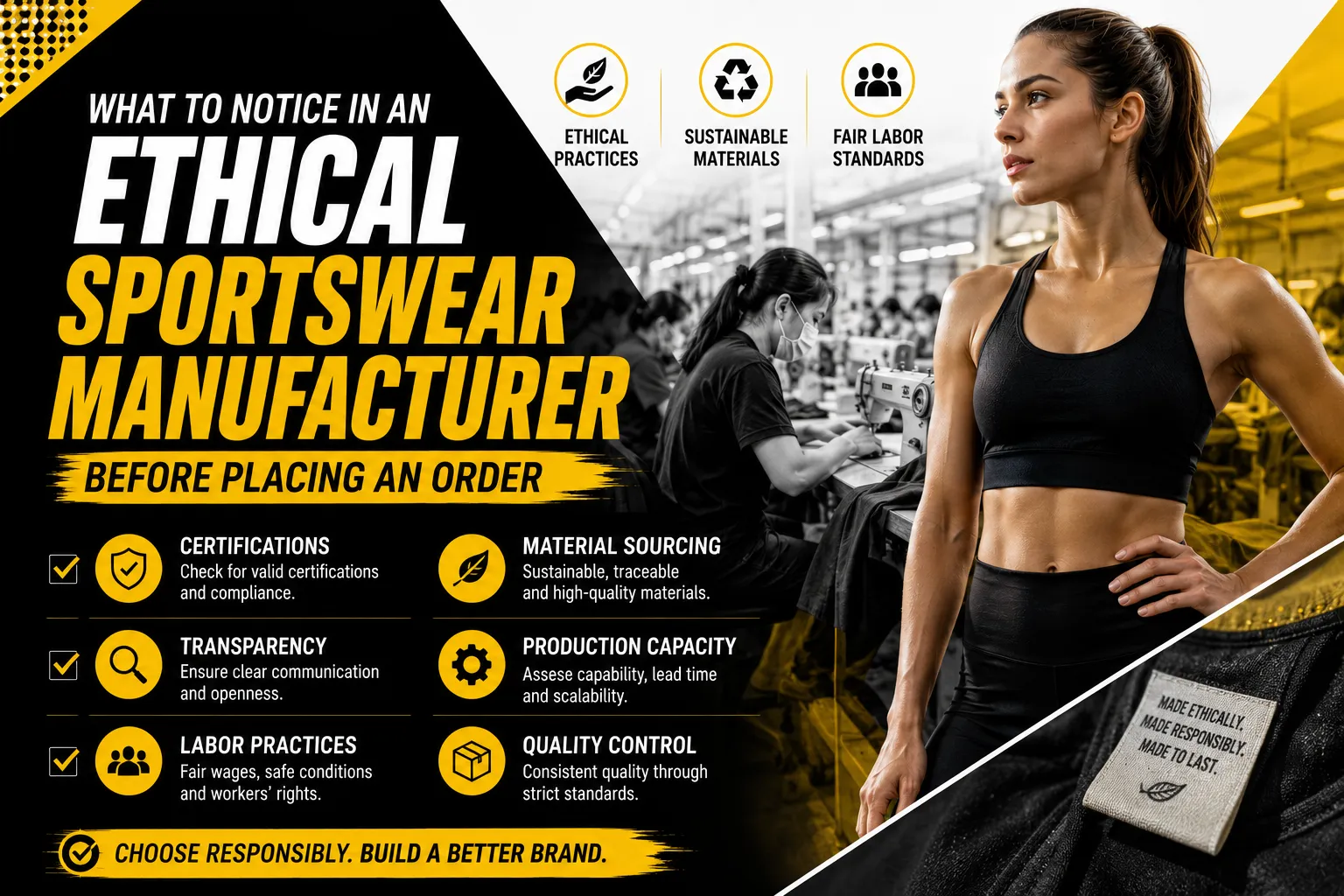
The Decision That Shapes Your Entire Brand
When you place your first or next sportswear order, you are not just choosing a supplier you are deciding how your brand will be represented in the market.
Every stitch, every fabric choice, every finishing detail that reaches your customer is a direct result of the manufacturer you choose. If they are inconsistent, your brand becomes inconsistent. If they are unreliable, your launch gets delayed. If they cut corners, your reputation absorbs the damage.
This is exactly why the most successful sportswear brands don’t rush into production based on price or promises. They evaluate manufacturers carefully before placing an order.
Because once production starts, you are no longer in the design phase you are fully dependent on their system.
In this guide, you’ll understand exactly what to notice in a manufacturer before you commit your order, so you can protect your brand from costly mistakes and long-term production issues.
Why the Manufacturer You Choose Matters More Than Your Product Design
You can have a strong design, a clear brand identity, and even a good marketing strategy but if your manufacturing is unstable, none of it holds up in the real world.
You experience this very clearly when:
- Your first sample looks perfect, but bulk production feels different
- Your sizing shifts slightly from order to order
- Your fabric quality changes without notice
- Your delivery timeline keeps moving
These are not small issues. In sportswear, even minor inconsistencies are immediately visible because your products are worn during movement, training, and high-performance activity.
When your customers notice discomfort, poor fit, or inconsistent quality, they don’t question the factory; they question your brand.
That’s why choosing the right manufacturing partner is not a cost decision. It’s a brand protection decision.
What Ethical Manufacturing Actually Means When You Are the Buyer
Forget the academic definition of ethical manufacturing. In real production decisions, it is much more practical.
When you evaluate a manufacturer, ethical manufacturing simply means this:
You can trust them to deliver exactly what they promised, every time.
Not once. Not for the first order. But consistently, as your brand grows.
From your perspective, this shows up in a few very real ways:
- You receive clear communication instead of vague answers
- Your fabric stays consistent across repeat production
- Your samples match bulk output without unexpected changes
- Your timelines are realistic and respected
- You are informed before problems become production issues
If any of these are missing, the risk to your brand increases immediately.
Ethical manufacturing is not about statements, it is about behavior during production.
What You Must Notice Before You Place an Order
Before you commit your production, there are a few areas you should always evaluate carefully. These will tell you more about a manufacturer than any portfolio or price list.
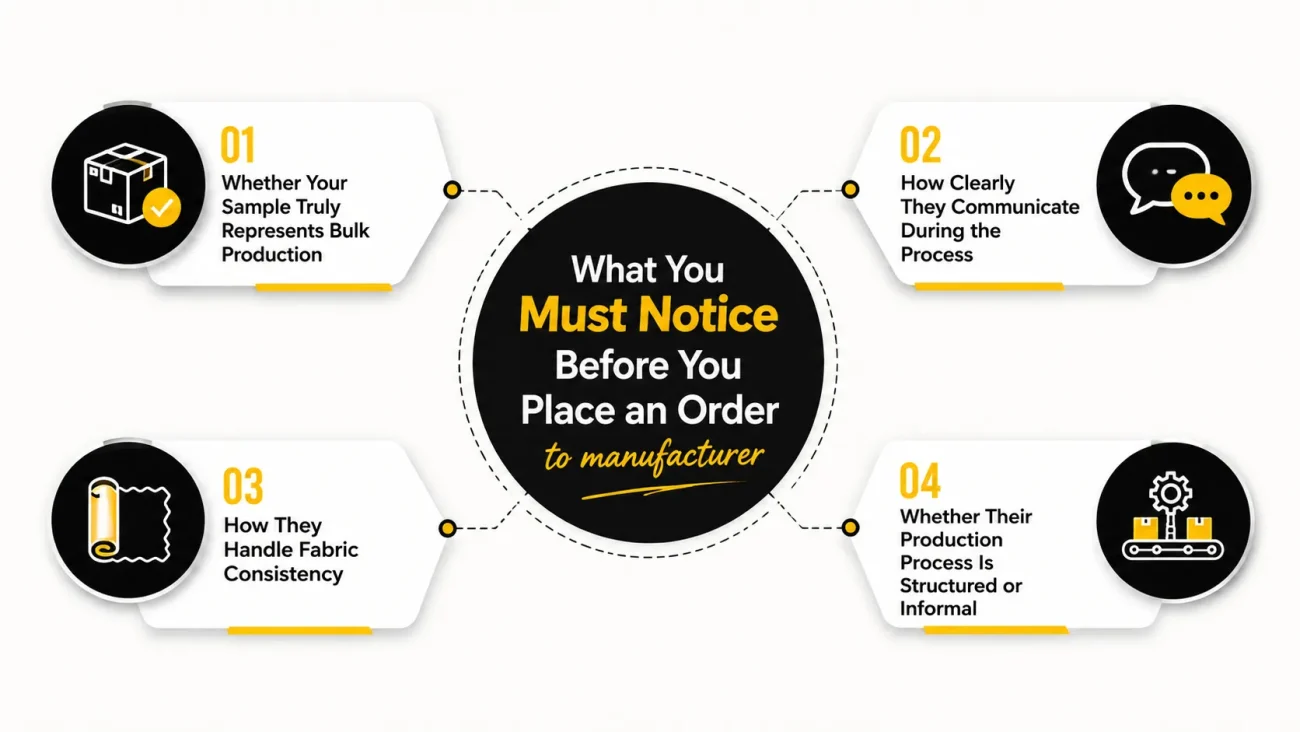
1. Whether Your Sample Truly Represents Bulk Production
Your sample is not just a reference it is a promise.
When you approve a sample, you are expecting that exact quality to be replicated in bulk production.
So you need to observe one critical point:
Does the manufacturer treat the sample as a strict production standard, or just a showcase piece?
If bulk production feels even slightly different in fabric, stitching, or finishing, it means their control system is weak. And that weakness becomes more visible as your order volume increases.
2. How Clearly They Communicate During the Process
Communication tells you how your entire production experience will feel.
You should pay attention to whether you are getting:
- Clear timelines without uncertainty
- Honest updates during production
- Direct answers when you ask technical questions
- Early warning if something is delayed or changed
If communication feels confusing before production even starts, it will not improve once your order is in process.
Good manufacturers don’t just respond, they guide you through production decisions.
3. How They Handle Fabric Consistency
Fabric is one of the most sensitive parts of sportswear manufacturing.
Even when designs remain the same, inconsistent fabric can completely change how your product feels and performs.
You should check whether the manufacturer has control over:
- Fabric sourcing for repeat orders
- Maintaining the same GSM and composition
- Avoiding unauthorized substitutions
- Keeping performance stable across batches
If fabric changes without your awareness, your brand consistency is at risk from the very beginning.
(Internal reference: Choosing the Right Fabric for Sportswear)
4. Whether Their Production Process Is Structured or Informal
A serious manufacturer follows a clear system, not random execution.
You should be able to understand their workflow clearly, something like:
Sample development → approval → fabric sourcing → cutting → stitching → quality inspection → finishing → packing
If a manufacturer cannot clearly explain their process, it usually means production control is reactive rather than structured.
And in sportswear, reactive production almost always leads to inconsistency.
(Internal reference: Realistic Production Timelines for Custom Sportswear)
How Quality Control Protects Your Brand After Production Starts
Once your order moves into production, quality control becomes the most important factor protecting your brand reputation.
At this stage, small mistakes are no longer theoretical they become physical products reaching your customers.
You should pay attention to whether your manufacturer has a real system for checking quality at multiple stages, not just at the end.
A reliable setup usually includes checks during cutting, stitching, finishing, and final inspection before packing. This ensures that errors are caught early instead of being discovered after shipment.
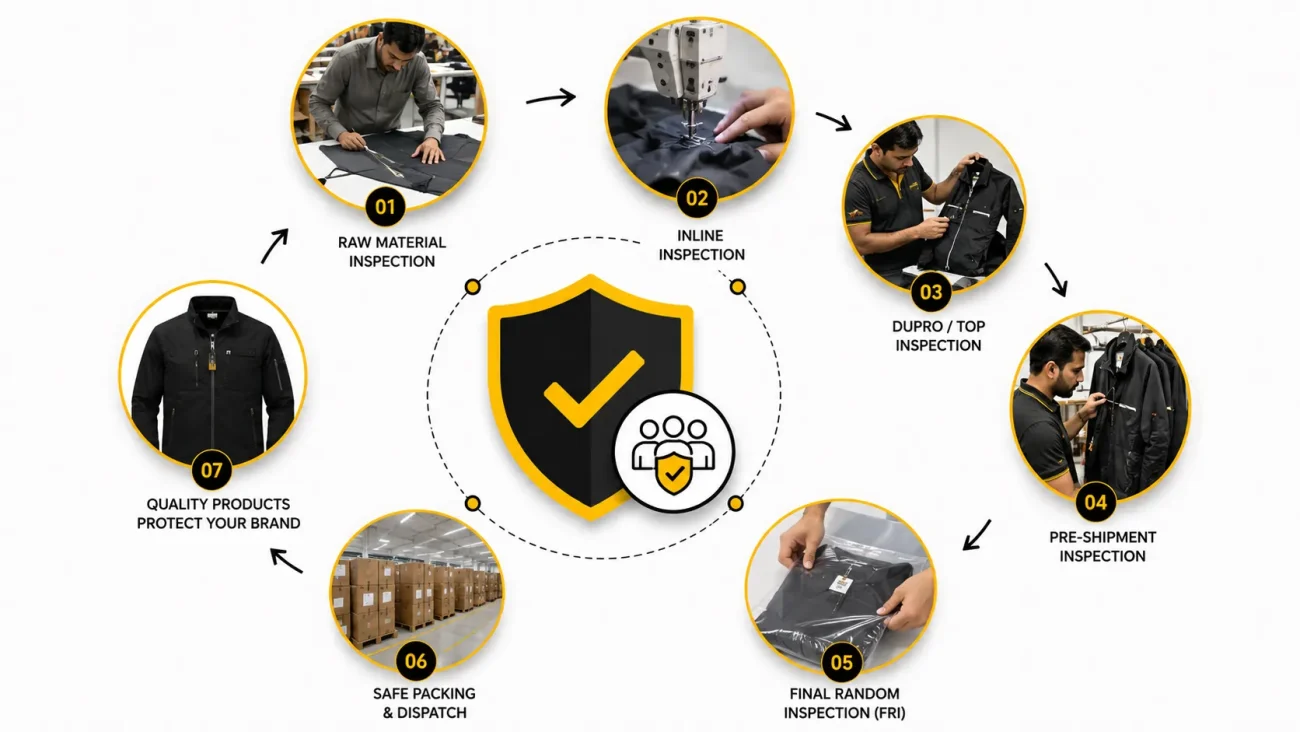
If a manufacturer only focuses on final inspection, you carry a higher risk of inconsistent pieces reaching your customers.
In sportswear, this matters even more because your products are used in movement, training, and repeated washing. Even small defects become noticeable quickly.
Red Flags You Should Never Ignore During Production
Even if the initial communication and sampling process feels smooth, you should stay alert during production.
There are a few warning signs that often indicate long-term risk for your brand:
If the manufacturer suddenly changes fabric without informing you, it shows lack of control over sourcing.
If timelines keep shifting without clear reasons, it usually means production planning is not stable.
If communication becomes slow once production starts, it signals weak operational discipline.
If bulk quality does not match your approved sample, it means there is no strict production benchmark being followed.
These issues rarely stay isolated. They usually repeat in future orders as well.
Your goal is to work with a manufacturer where these problems do not exist in the first place, not one where they need to be corrected repeatedly.
Why Export Readiness Is Part of Ethical Manufacturing
If you are building a sportswear brand for international markets, export readiness becomes a critical part of manufacturing reliability.
It is not just about producing garments it is about how those garments are prepared for global distribution.
You should observe whether your manufacturer understands:
- Proper packaging standards for international shipping
- Accurate labeling and size marking
- Carton organization and protection during transit
- Documentation required for export shipments
When these elements are handled correctly, your production moves smoothly from factory to customer without unnecessary complications.
If they are ignored or treated casually, you may face delays, customs issues, or damaged goods during transit.
For growing brands, export readiness is not optional, it is part of building a scalable business.
The Real Cost of Choosing the Wrong Manufacturer
Many brands focus on unit cost when selecting a manufacturer, but the real cost becomes visible later.
If your production is inconsistent, you end up dealing with returns, refunds, and customer complaints.
If sizing is not stable, you lose customer trust.
If delivery is delayed, your marketing campaigns and launches get affected.
If fabric quality changes between batches, your brand loses identity consistency.
These issues do not just affect one order, they affect your long-term growth.
In most cases, the cost of fixing these problems is much higher than the initial savings from choosing a cheaper supplier.
That is why experienced brands focus on reliability instead of just pricing.
What Ethical Manufacturing Looks Like in Real Production
Ethical manufacturing is not a theory it is visible in how production is executed on the ground.
When you are working with a strong manufacturer, you will notice a few clear behaviors:
Your approved sample is treated as the exact reference for bulk production.
Any fabric or material decision is confirmed with you before execution.
Production updates are shared transparently instead of being hidden until shipment.
Quality is checked during production, not only at the end.
Issues are communicated early so you can make informed decisions.
This kind of structure ensures that your brand receives consistent output, even as order volumes increase.
It also reduces uncertainty, which is one of the biggest challenges for growing sportswear brands.
What You Should Expect From a Serious Sportswear Manufacturer
Before placing your order, you should be clear about what a professional manufacturing partner looks like.
You should expect:
A structured sampling process that helps you refine fit and quality before bulk production.
Consistent fabric sourcing that does not change between orders without approval.
Clear and realistic production timelines that are followed, not adjusted repeatedly.
A quality control system that checks garments at multiple stages.
A communication process that keeps you informed instead of leaving you uncertain.
And most importantly, a long-term mindset where your brand growth is considered part of the partnership.
If these expectations are not met, scaling your brand becomes difficult regardless of how strong your designs are.
How We Approach Manufacturing at Natural Grace Sports
At Natural Grace Sports, we work with brands that are building long-term sportswear businesses, not one-time orders.
That is why our production approach is built around consistency, communication, and structured execution.
From sampling to bulk production, every stage is handled with clear checkpoints so your final product matches what you approved.
We focus on maintaining stable quality across repeat orders, ensuring fabric consistency, and keeping communication clear throughout the process.
Our goal is simple: when your customer receives your product, it should reflect the standard your brand stands for every single time.
Final Thoughts
Choosing a sportswear manufacturer is not just a production decision. It is a brand stability decision.
When you evaluate a supplier carefully before placing your order, you reduce risk, protect your brand reputation, and create a foundation for long-term growth.
Ethical manufacturing is not about claims or labels, it is about whether your manufacturer can consistently deliver what your brand promises to the market.
If you are planning your next sportswear collection and want a reliable production partner who understands consistency, scalability, and export-level quality, the right manufacturing foundation makes all the difference.


